Life Science (Reagent)We will share various news about iNtRON

PCR

RedSafe™ Nucleic Acid Staining Solution 
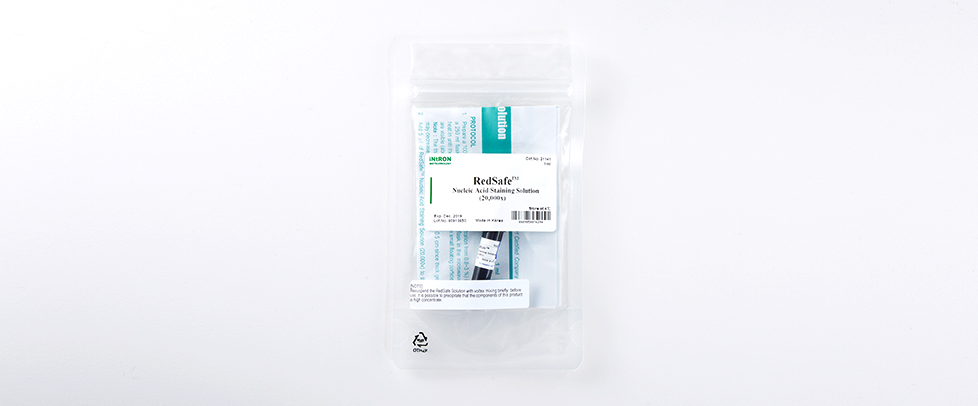
Cat.No Capacity Inquire
21141 1 ㎖ Inquire
PRODUCT INFORMATION
Description

RedSafe™ Nucleic Acid Staining Solution is a new and safe nucleic acid staining reagent, a substitute for EtBr (ethidium bromide).


Characteristics

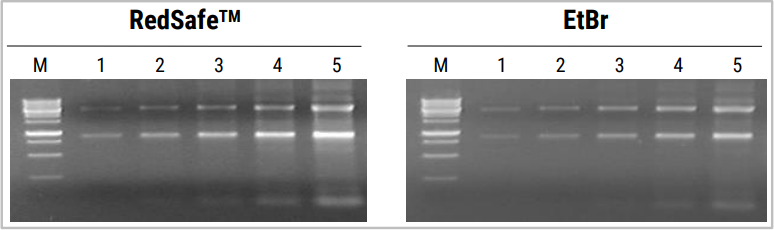
• RedSafe™ Nucleic Acid Staining Solution is easy and convenient to use, offering higher sensitivity than EtBr.

• It has significantly lower genotoxicity compared to EtBr, ensuring user and laboratory safety.

• When bound to nucleic acids, it becomes visible at 520–540 nm (optimal with a 530 or 535 nm filter).

Application

• Visualization of DNA and RNA bands during agarose gel electrophoresis.

• Isolation of DNA fragments for subcloning while minimizing mutation risks associated with EtBr.

• Both Precasting and Post-Staining are all possible.

Kit Contents
No. Kit Contents Unit
1 Staining Solution 1 ml x 1 vial
2 Manual 1 ea
Storage

• RT, Room Temperature : Stable for more than 12 months

• For more stable use, should be store at 4℃ (Stable for more than 24months).

Technical Data

1. Spectrum


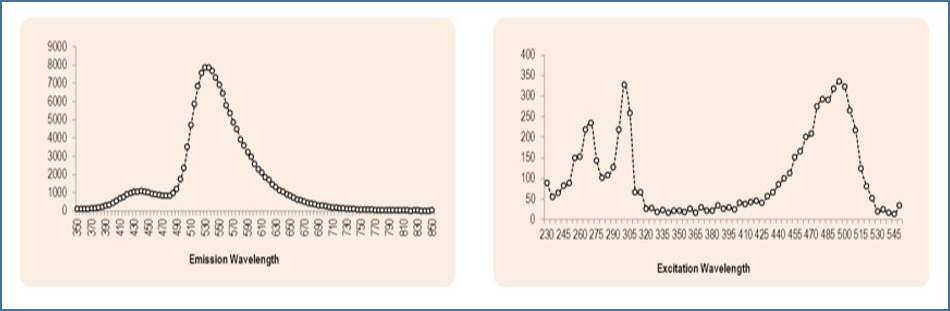
Excitation wavelength (EX) / Emission Wavelength (EM)


Excitation (EX) and Emission Wavelengths

EM scan at 306 nm EX showed the highest center peak at 530-535 nm.

EX scan at 535 nm EM revealed multiple peaks, with the center peaks at 270 nm, 300 nm, 480 nm, and 495 nm.


Excitation Capabilities

RedSafe can be excited not only by the UV light typically generated by a UV Transilluminator, but also by a wide range of visible light wavelengths, specifically in the 420-510 nm range.


Emission Characteristics

Upon excitation, RedSafe emits a strong fluorescent signal at 535 nm, which is in the green-yellow region of the visible spectrum.


2. Filter Selection


The Image Analyzer used after electrophoresis is composed of a UV transilluminator, a camera, and analysis software. In most cases, a filter that can selectively transmit only specific wavelengths of light is either attached or can be selected in front of the camera lens mounted on the equipment.


When using an EtBr Filter

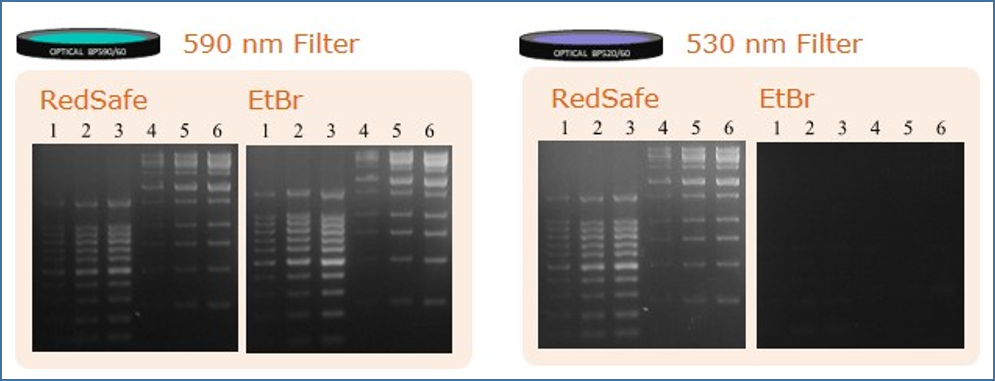
If the existing laboratory equipment is equipped with an optimal 590 nm filter for EtBr, the fluorescent signal of RedSafe may still be detected, but it may be difficult to obtain the best image.


When using a 520-540 nm range filter

When using a filter in the 520-540 nm range, which is suitable for RedSafe, the RedSafe bands will appear brighter and more distinct. However, in this range, the EtBr bands will hardly be visible. Therefore, if you want to obtain optimal electrophoresis results using RedSafe, it is recommended to use a 530 or 535 nm filter.

When no filter is available

Even if there is no filter suitable for RedSafe, it is still possible to obtain electrophoresis images. However, if the UV transilluminator is set to a high output, the UV ramp behind the gel will be captured, resulting in a blurry background. In this case, reducing the UV ramp output to 40% or less, so that the light bulb is not visible, will allow for good images of both RedSafe and EtBr.


3. Post-Staining


Typically, for easy and convenient electrophoresis, RedSafe is commonly added during agarose gel preparation (Precasting method). However, due to the nature of electrophoresis, as the run time continues, RedSafe tends to migrate upwards (+charge) while DNA moves downwards (-charge). This results in a non-uniform background, where the upper portion appears brighter and the lower portion appears darker (It is a characteristic of all staining dyes, including EtBr).


Occasionally, there are inquiries about the possibility of Post-staining to maintain a cleaner experimental environment or achieve a more uniform gel background. The good news is that Post-staining is indeed possible.

The procedure for Post-staining is similar to that of EtBr. To perform Post-staining, the final concentration of RedSafe should be diluted to 1x in the running buffer, and the gel should be incubated for approximately 10 minutes. This will result in a clean electrophoresis image with a uniform background. Additionally, the even distribution of RedSafe throughout the gel will allow for relatively bright visualization of even small DNA fragments.

TroubleShooting Guide
                                    
QYou are currently using EtBt.
ARedSafe™ is a safe nucleic acid staining reagent with no toxicity or carcinogenicity as a substitute for EtBr. This product is the same as EtBr and emits green fluorescence when exposed to UV light. 
QI am using RedSafe™, which is harmless to the body when I use EtBr. I have a band that is blurred compared to EtBr.
AHave you been agarose gel for a long time? RedSafe™ is less persistent than EtBr because it is designed to not pass through the human mucosa. Therefore, when using RedSafe™, you can get the same result as EtBr if you use fresh gel. 
QI would like to compare Invitrogen's SyberSafe with iNtRON's RedSafe™ Nucleic Acid Staining Solution as an EtBr replacement. Can I request a sample?
AThank you for your interest in our products. This product is a new and safe nucleic acid staining reagent as a substitute for EtBr (ethidium bromide) used to identify nucleic acid in Argarose gel, and it emits green fluorescence. Samples will be processed through our sales representative as soon as possible. 
Related Product
관련제품 Product,No,Capacity,Inquire list
Product Cat.No Capacity inquire
Maxime™ PCR PreMix (i-Taq) Best
25025 96 tubes (20 ㎕) Inquire
25026 96 tubes x 5 ea Inquire
2X PCR Master mix Solution (i-Taq) Best
25027 0.5 ㎖ x 2 vials Inquire
i-Taq™ DNA Polymerase
25021 250 unit Inquire
25022 500 unit Inquire
Agarose LE Best
32034 500 g Inquire
SiZer™-100 DNA Marker Solution Best
24073 0.5 ㎖ Inquire
6X Agarose Gel Loading Buffer
IBS-BA006 10 ㎖ Inquire

List

TOP