LiliF Diagnostic KitsMore Simple, More Accurate, More Effective

Veterinary MDx

LiliF® AIV M Real-time RT-PCR Kit (Fast ver.)
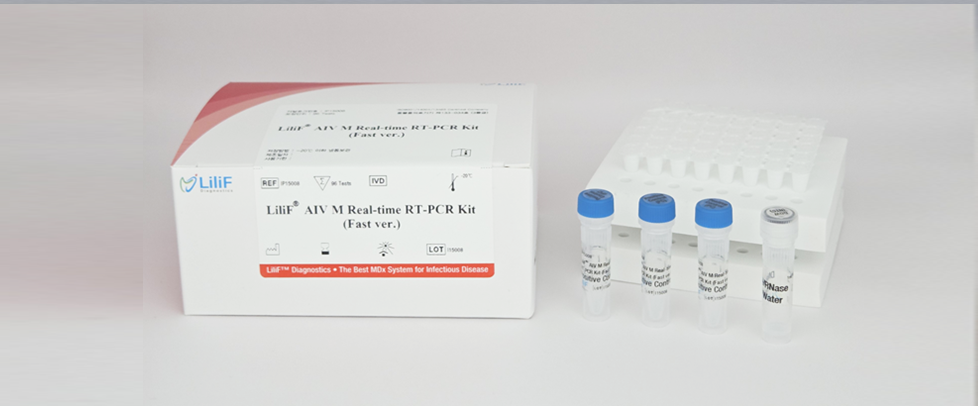
Cat.No Capacity Inquire
IP15008 96 tests Inquire
PRODUCT INFORMATION
Description

A fast and reliable real-time RT-PCR solution for qualitative detection of Influenza A virus through M gene targeting.

    • Specifically detects the M gene of Influenza A virus for avian influenza molecular diagnostics.
    • Reduces testing time from approximately 2 hours 10 minutes to within 1 hour while maintaining performance equivalent to the conventional version.
    • Validated using oropharyngeal swabs, cloacal swabs, feces, and tissue homogenates from chickens and ducks.
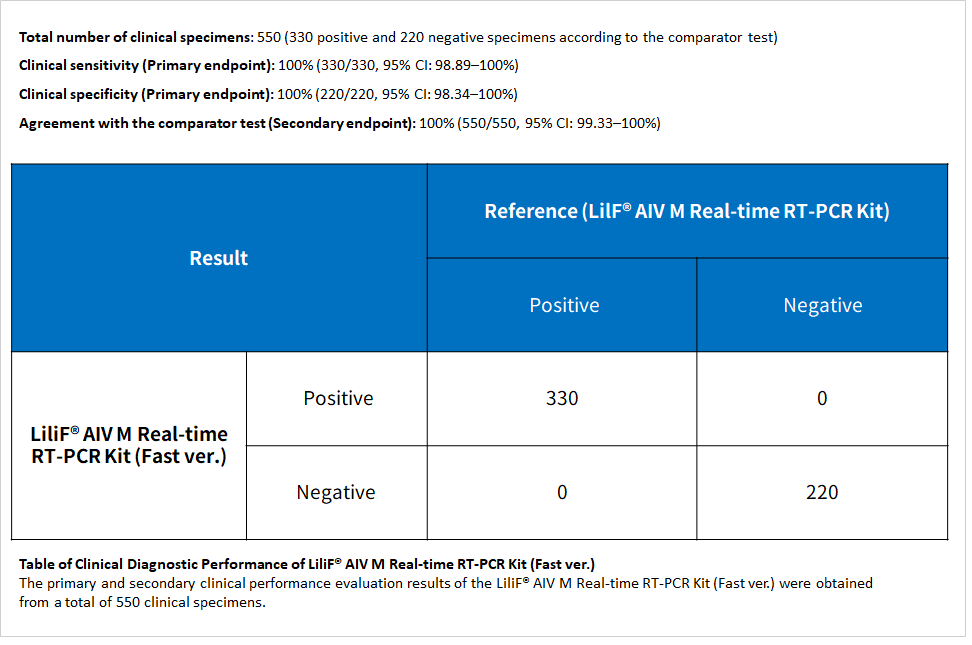
    • Demonstrated 100% clinical sensitivity and 100% clinical specificity in the reported clinical evaluation.
    • Showed no observed cross-reactivity with the tested viral pathogens NDV, IBV, and IBDV, or bacterial pathogens including Salmonella enteritidis, Bacillus cereus, and Escherichia coli.

LiliF® AIV M Real-time RT-PCR Kit (Fast ver.) is a qualitative real-time RT-PCR assay designed for specific detection of the M gene of Influenza A virus. The fast workflow shortens the testing time to approximately 1 hour, more than twice as fast as the conventional version, while maintaining equivalent sensitivity and specificity in the reported evaluation.

The kit has been evaluated with clinical specimens from chickens and ducks, including oropharyngeal swabs, cloacal swabs, feces, and tissue homogenates. The reported results showed consistent Ct performance across different sample conditions and no PCR inhibition in the evaluated specimens.

Applications

01

Qualitative detection of Influenza A virus by M gene targeting

02

Testing of oropharyngeal swabs, cloacal swabs, feces, and tissue homogenates from chickens and ducks

03

Rapid molecular testing for avian influenza virus

04

Veterinary diagnostic and avian influenza surveillance workflows

Kit Contents
Contents Quantity
AIV M qRT-PCR PreMix (Fast ver.) 20 μl × 96 tubes
Positive Control 25 μl × 3 tubes
DNase/RNase-Free Water (Negative Control) 1 ml × 1 tube
Instructions for Use 1 copy
Technical Data

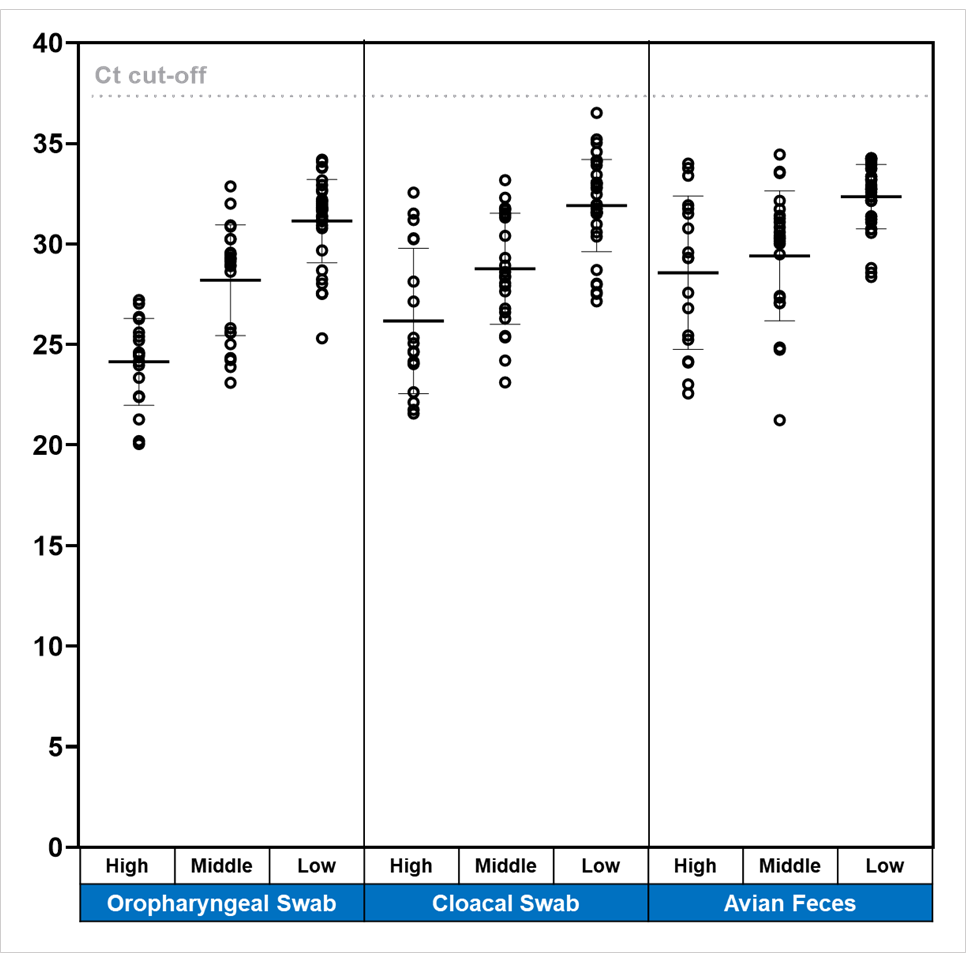
Consistent Ct Performance Across Sample Types

Evaluation across different clinical specimen types and Influenza A virus concentrations demonstrated consistent Ct values. The kit showed stable target detection across the evaluated specimens, including oropharyngeal swabs, cloacal swabs, and feces from chickens and ducks.
  

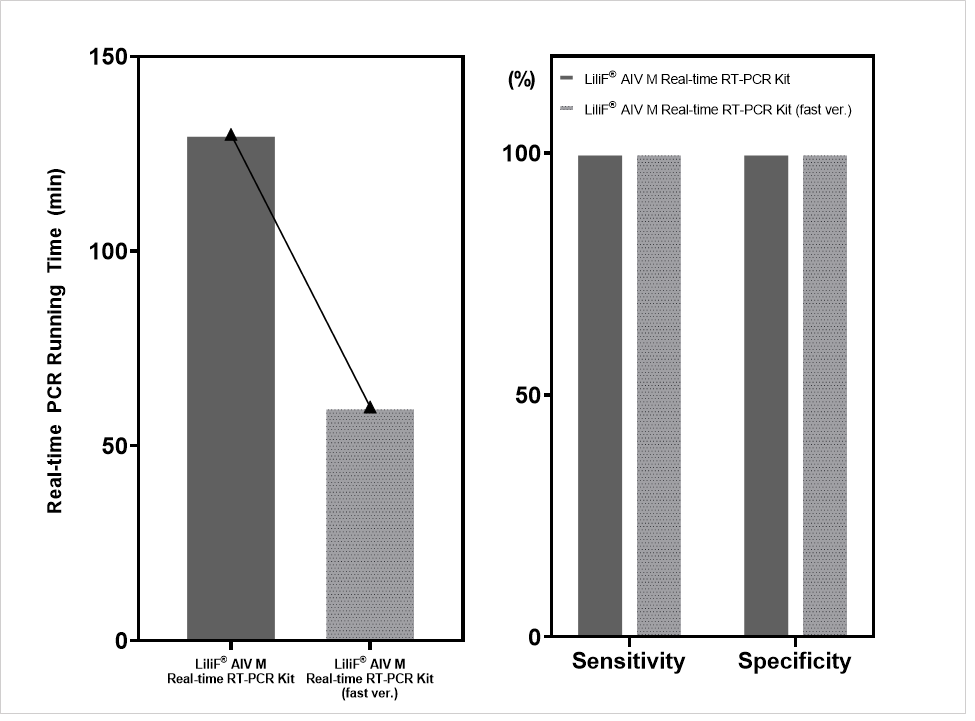
Over 2× Faster Testing with Equivalent Diagnostic Performance

The fast version reduces the reported real-time RT-PCR running time from approximately 130 minutes to within 60 minutes compared with the conventional LiliF® AIV M Real-time RT-PCR Kit. The evaluation reported equivalent sensitivity and specificity between the two versions.
  

Clinical Performance: 100% Sensitivity and Specificity


Analytical Specificity

No cross-reactivity was observed with the tested viral pathogens, including Newcastle disease virus (NDV), infectious bronchitis virus (IBV), and infectious bursal disease virus (IBDV), or with the tested bacterial pathogens, including Salmonella enteritidis, Bacillus cereus, and Escherichia coli.

TroubleShooting Guide
Q
What should I do if the Positive Control (PC) does not show amplification?
A
Verify that the Positive Control was added correctly and that the prescribed reaction volume and cycling conditions were followed. Ensure that the AIV M qRT-PCR PreMix (Fast ver.) was completely thawed and briefly centrifuged before use. Confirm that the kit was stored at ≤ −20°C and has not exceeded its expiration date or recommended period after first opening. If the Positive Control continues to fail, repeat the test with fresh kit components and verify the instrument settings.
Q
Why is amplification detected in the Negative Control (NC)?
A
Amplification in the Negative Control may indicate contamination of the reaction system. Use the supplied DNase/RNase-free water as the Negative Control and handle it separately from the Positive Control and specimens. Prepare reactions in a clean work area, use filter tips, and avoid transferring material between tubes. Decontaminate the work area and repeat the test with fresh reagents. Do not interpret results from a run with suspected contamination until the issue has been addressed.
Q
What should I do if the specimen result is classified as Invalid?
A
An Invalid result may occur when the required control results are not obtained. Review the M gene (FAM) and Internal Positive Control (IPC, HEX) signals together with the Positive and Negative Control results. Check for possible pipetting errors, incorrect reaction setup, or problems with nucleic acid extraction. Repeat the test according to the laboratory's established procedures. Ensure that the controls meet the expected criteria before interpreting specimen results.
Q
What does it mean if the Internal Positive Control (IPC, HEX) is not detected?
A
The IPC is an exogenous DNA control independent of specimen type. If the M gene target is not detected and the IPC signal is also absent, the result may be Invalid and should be reviewed before reporting. Check the nucleic acid extraction procedure, specimen quality, reaction setup, and potential PCR inhibition. In strongly positive specimens, failure to detect the IPC does not affect interpretation of the positive target result, as specified in the product instructions.
Q
How should results near the M gene cut-off value be interpreted?
A
For the CFX96 system, the M gene (FAM) cut-off is Ct ≤ 37 for a positive result; Ct > 37 or no Ct is interpreted as negative according to the product instructions. The IPC (HEX) reference range is Ct 20–25. Confirm that the baseline and threshold settings are set to Auto and that the correct fluorescence channels are assigned. If a result is inconsistent with the control results or other findings, review the run and repeat testing in accordance with the laboratory's procedures.
Q
Why is the M gene target not detected in a specimen suspected of avian influenza?
A
Confirm that the specimen type is appropriate and that nucleic acid extraction was performed according to the extraction kit manufacturer's instructions. Testing immediately after extraction is recommended. Verify the reaction setup and instrument program, including signal acquisition at 60°C for 15 seconds during amplification. PCR inhibitors in clinical specimens or sequence variation in the target region may contribute to false-negative results. Review the IPC and control results before interpreting the specimen as negative.
Q
Why do Ct values vary between runs, and can they be used for quantitative analysis?
A
Differences in specimen handling, nucleic acid extraction, pipetting, reagent storage, and instrument settings may affect test results. Ensure that each reaction contains 20 µL of AIV M qRT-PCR PreMix (Fast ver.) and 5 µL of specimen RNA, Positive Control, or Negative Control, as appropriate. Mix thoroughly and briefly centrifuge the tubes to remove air bubbles and collect the reaction mixture at the bottom. Avoid repeated freeze-thaw cycles and do not mix reagents from different lots. The reported Ct values exclude the five pre-amplification cycles and must not be used for quantitative analysis.
```
Related Product
관련제품 Product,No,Capacity,Inquire list
Product Cat.No Capacity inquire
LiliF® AIV H5 Real-time RT-PCR Kit Best
IP15005 48 tests Inquire
LiliF® AIV H7 Real-time RT-PCR Kit Best
IP15006 48 tests Inquire
LiliF® AIV M Real-time RT-PCR Kit Best
IP15004 48 tests Inquire
LiliF® AIV HA (1-16) Multi-tube RT-PCR Kit
IPC12020 6 tests Inquire
LiliF® AIV 5/7/9 Multi qRT-PCR Kit New
IP15007 96 tests Inquire
Protocol

List

TOP